Have you ever asked yourself, why the vast majority of people use either a Windows or a macOS computer? Or how it can be, that there’s virtually only one office suite (Microsoft Office), that uses de facto vendor-locked file types (.docx, .xlsx, .pptx). Or when software started to be a rental product, for which you need to keep paying money monthly or yearly? And why, despite this rental charge, those tools still collect and track your data, and violate your privacy at every moment?
I think - sadly - most people rarely ask themselves such questions.
We live in a world full of abundant choices, competition and perceived freedom. But, when it comes to our computers and smartphones, on which we spend a large chunk of our days, we simply accept these monopolies or duopolies.
But what if we didn’t just accept this? What if we start questioning proprietary software, offered and owned by large corporations?
In the eyes of computer legend Richard Stallman, proprietary software and its producing companies are socially corrupt and evil, because they prioritize control over users for profit, by restricting their freedoms. That is why Stallman coined the term “free software” in the 1980s.
What is FOSS?#
Free software, more broadly also referred to as free and open-source software, or FOSS for short, describes software that is licensed to grant users the freedom to run, study, modify, and redistribute it, ensuring they have control over their own computing.
In simpler terms: FOSS is software that you can use freely. You can find its source code online, download the application or tool and modify it however you’d like.
Let’s take the example of Microsoft Word. If I want to use this software, I need to have a Microsoft account and buy a license from Microsoft. This license will grant me usage of this software, for only a limited amount of time. I don’t own this software. I am only allowed to rent it for a limited time. I can’t see the source code that Microsoft wrote for this application. I don’t know, what is happening under the hood, how the application is doing what it’s doing, and whether it might be doing something else that I didn’t even ask it to do.
Remember the good old days, when you bought yourself a CD and installed Microsoft Word on your computer and actually owned it? Those times are long over…
A famous FOSS alternative to Microsoft Word is LibreOffice Writer. I can download this software from various different sources, such as the official website of the Document Foundation, which maintains this application as a non-profit organization driven by volunteers. I don’t need any account to use this software. I can use it free of charge, for as long as I want. I am not obliged to pay the developers any money for it. Of course, if I want to show my appreciation for developers, I can donate them some money, but this is my own free choice. I can also find the complete source code for this application online. I can see what is happening under the hood, and if I have the ability, I can even make modifications to the code.
Now this sounds much better, doesn’t it?
So, what are the high-level characteristics of FOSS? In my view, these are the following:
Freedom: FOSS is free. This can mean the software is gratis, but it must mean the software is libre - which means it can be accessed, downloaded, used, inspected, modified and shared by anyone, without discrimination.
Decentralization: Because these types of software can be modified and shared freely, the FOSS universe is generally decentralized. Software can be forked (essentially copied and modified), which is why you will often see many different variants of the same software, of competing projects that share a part of their history. In the example of LibreOffice, this is a fork of OpenOffice, which itself was a fork of StarOffice.
Community: Unlike proprietary software, FOSS does not draw a boundary between the developers and users of software. A user of FOSS will usually also, in some way or another, become a contributing member of this community. This includes contributing code, documentation, translations, artwork, other work, or simply money.
So now that we have a clear understanding of proprietary and free software, let’s take a look at the three main advantages of FOSS.
Three Advantages of FOSS#
The first and most obvious advantage of FOSS is that it’s free - first and foremost in the sense that it is libre, as in freedom. But a lot of FOSS is also gratis, or free in the sense that it can be used free of charge.
Gratis software is relevant, especially for people in developing countries and people with low income in general. Students, artists, non-profit organizations and many more benefit from or even rely on this fact. FOSS democratizes and liberates the access to computers and software, which are necessary, fundamental tools in our modern world.
Imagine a world with only proprietary programming languages instead of C, Java or Python. The potential pool of talent that could use these programming languages would be extremely limited!
The second advantage is that FOSS does not seek profit. Seeking profit can easily and quickly lead to misaligned incentives to exploit you as the user. While Microsoft tracks your data and constantly tries to upsell your software subscription, FOSS won’t do that. While closed-source web applications like YouTube rely on selling ads, and tracking and selling your data directly increases their revenue, decentralized open-source alternatives like PeerTube have no ads and hence no incentive to sell your data.
The third advantage concerns the community. Because every person in the FOSS universe is not only a user, but also a participant in some way or another, collaboration is fostered. FOSS is all about creating value, sharing information, and helping others. A community built on these principles is simply beautiful. Of course, it does not mean that you won’t find any conflict or mean people in the FOSS space - but overall the community around FOSS is just amazing.
But… isn’t FOSS super clunky?#
Okay, you might think, FOSS sounds like a beautiful, idealistic idea. But isn’t it super difficult to use and not very user-friendly?
Let’s talk about that. First of all, there are A LOT of FOSS software that is absolutely superior to its closed-source competition. Examples include Blender, OBS Studio, Godot, or Syncthing. Personally, I would include Linux in this list, as it is, in my opinion, superior to Windows and macOS in almost every category.
I would further argue that a lot of these tools are not inherently more difficult to use than their proprietary counterparts. It’s mostly just that we are so used to using the proprietary tools. Almost all of us know how to use Microsoft Excel, because it is a basic skill required for many office workplaces. Therefore, using LibreOffice Calc can feel more difficult, simply because we are not used to it.
Also, if not for the proprietary and locked nature of hardware drivers and file types, FOSS could be an even smoother experience than it already is.
Let’s now talk about user-friendliness.
Is FOSS as smooth and integrated as proprietary software? Does it give you the “one-stop-shop” experience like Microsoft 365 or Google Workspace?
Usually, it doesn’t (although there are people working on improving this).
Unlike proprietary ecosystems (e.g. Apple or Microsoft), FOSS lacks a single vendor enforcing uniform design across all tools. While some companies (e.g. Canonical, Red Hat) offer integrated stacks, the broader FOSS landscape remains decentralized, which can lead to some inconsistencies and confusion.
Look at this highly simplified map of popular Linux distributions, for instance:
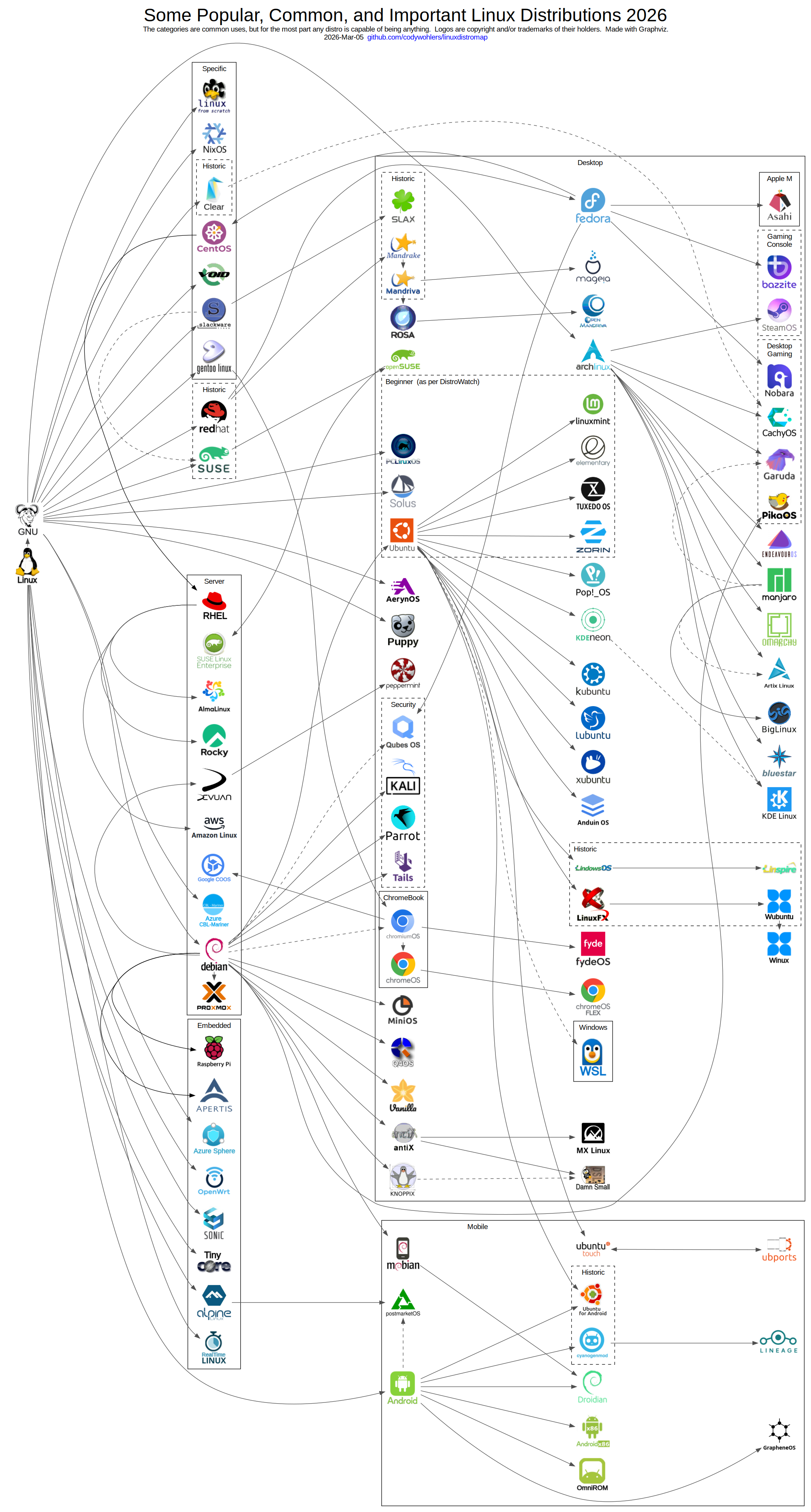
For new people in the FOSS space, this kind of heterogeneity can be overwhelming.
However! Is proprietary software really user-FRIENDLY? Try setting up Windows without a Microsoft account, or an iPhone without an Apple account. How’s your experience? Do you feel being treated very friendly?
Is it friendly to track your data? Is it friendly to force you to use certain apps? Is it friendly to hide data privacy settings from you? Is it friendly to shove AI into your face at every corner? And is it friendly to try to earn as much money from you as possible?
I think you get my point.
The Future of Computing#
FOSS is like the good guy fighting the dark side of the force. It is built on a strong ethical and moral foundation and challenges proprietary software by prioritizing user freedom, transparency, and control.
Despite the fierce competition put up by proprietary software vendors, who can spend millions on marketing, advertising and design, FOSS has stood its ground in the last decades. Most servers run Linux, and the desktop market share has never been as high as now. Virtually all software products - proprietary or not - depend on FOSS tools and components. More and more people start questioning Big Tech and their shady practices.
FOSS is the shiny alternative waiting for everyone curious enough to ask questions and courageous enough to give it a try.